Saturday, 2 September 2017
Coming Full Circle
When something comes full-circle it means that it has completed its cycle, and returned to where it first began. As I write this blog post, I am coming up on the end of my 90-day cycle here in Belize. It’s been over 80-days since I first arrived in Belize and I have just under a week left in the country; even less than that, I have only 3 days left in Punta Gorda Town, the place I have come to call home over the past nearly 3 months.
I am in Belize on an internship coordinated through CELA, the Center for Engaged Learning Abroad; I have been working with the Maya Leaders
Alliance (MLA), an indigenous social justice organization, in the Toledo District of Belize documenting the customary law of two of the Maya communities here. MLA’s office is in Punta Gorda Town, locally known as PG, which is the hub of the Toledo District, an otherwise rural district in the south of Belize.
I remember my first time being driven into PG with my CELA supervisor, Dr. Filiberto Penados – it had been a long 4-hour drive from the Cayo District where I had my orientation into Belize, and my attempts to orient myself on the winding roads were too easily lost with each speedbump and pothole we hit on our way into town. When we arrived in town, we parked at a local snack shop for lunch before Dr. Penados took us to MLAs office where we would be spending most of our time over the next 12 weeks.
A few days later, after only a couple more short drives through town and a quick introduction to the layout of the town on a map, I had convinced myself that I could find my way around and I was ready to start exploring, my first mission: to find my way back to the snack shop we had stopped at on our first day. My internship partner and I readied ourselves to walk into town and do some discovering in our new home before stopping for lunch again. Our first mistake: it was noon, and while that means “lunchtime” what it also means in Belize is “stay indoors and out of the sun at ALL costs”.
If I’ve done a good enough job of foreshadowing my lack of directional skills it should be obvious that we never did find that lunch shop that day. Not only that, but we got ourselves lost in the height – rather, the HEAT – of the day. That day was the first that I learned how easy it is to sweat through your shirt in 35 degrees and 90% humidity (something which I have since become very accustomed to). We had been walking for nearly 45 minutes when I realized that we had walked a circle, in fact, we had literally come full-circle and had ended up just a few blocks from our office where we had begun.
Today, after nearly 90 days living in PG, I always think back on this story with a smile, especially while I stroll past that same snack shop on my way to the market for some fresh fruit or to my favorite local café for a cold juice. Just days from now, when my time in PG comes to an end, I have the opportunity to go full-circle again, though in a very different way.
To me, one of the best ways to approximate how much you have changed over a period of time is to return to a place, or an experience, you first started with and to see how your perspective on your surroundings has changed. Soon, Dr. Penados will be returning to PG to accompany my partner and I in our final presentations and then, to drive us out of town one last time on our way back to the Cayo District. I know that, this time as we drive on that pothole-filled road out of town, in the opposite direction from when we came, my time spent in PG will have changed the way I see and experience my surroundings. Each time I have re-lived the drive into PG throughout my time here – usually on a rumbling bus returning from a village or on my bike returning from a windy ride down the highway – I am surprised by how well I have come to know the town and the roads I ride on. I am able to avoid the potholes with ease, and the places which seemed so unfamiliar to me before are now etched onto a map in my mind. I find myself asking: how is it that a place which seemed so unfamiliar to me just 3 months ago can now feel so much like home? The answer is simple: from the home-stay families I lived with, the village leaders in Santa Cruz and Laguna I learned so much from, and my coworkers I worked with, I have been welcomed into the homes of so many as if they were my own.
The local families which I have had the privilege of staying with over the past 3 months have opened their homes and their hearts to me. They have treated me like family and in turn I have come to see them that way, too. Many of the times I have been in the villages for work, conducting meetings and speaking with village leaders, I have also been welcomed into their homes with graciousness and generosity. Very soon I came to realize that my trips to village were not only about work, but much more than that, they become an opportunity for me to build friendly connections with my partners and to learn about Maya life in a genuine way. My coworkers have come to treat me not only as a valued member of the team, but also as a friend and a member of their ever-growing family of interns and allies.
It is these connections which make my internship experience special. No matter how long I spend away, I know that I built connections with the people I met here and that when I return those connections will still exist; no matter how long I spend away, I know that when I return, I will still know how to navigate that winding road and all the potholes on the way into PG; most importantly, I know that my impact as an intern and volunteer will live on in these connections and in the work that the Maya people of Southern Belize continue to engage in every day.
Sunday, 24 January 2016
10 Tips For Future Interns Coming To Belize
Today was possibly the most uneventful day I’ve had in Belize, but I’m not complaining about it. I love being lazy on the weekends. I slept late, caught up with my family at home, and relaxed quite a bit. This time allowed me to think what advice I would give to a new intern concerning the work culture in Belize. My advice is as follows:- Have an Open Mind: This will likely be a totally new experience for you. It’s important to understand that things will be different than you expect. Try to understand why things are different.
- Keep Busy: You will not always have an assignment to do or something clear to work on. During these times, keep busy in another way to help the office. If push comes to shove, work on something else (i.e. journal entries or something else productive).
- Ask Questions: Assignments can be confusing. Explanations for the assignments can be confusing and broad. You want to do the work right and you will need help from coworkers.
- Don’t Get Frustrated: This is a learning experience. There will be challenges and frustrating circumstances. Don’t let them get to you. Understand that this is all a process that will better you professionally for the future.
- Expect Slow Days: For many, this will be your first time spending significant time in an office. Combining that with the heat can sometimes make the day drag.
- Take Initiative: Don’t wait to be told what to do. Always ask if someone needs help with anything. Taking initiative can help solve a lot of other problems (i.e. staying busy, controlling frustration).
- Make Comparisons, Not Judgments: It's important to compare your idea of US work culture with Belizean work culture. What could the US learn from Belizeans? Anything you could advise the Belizeans to consider?
- Understand Your Role: Having a good understanding of your role in the office will make things run smoothly. It can be frustrating if you do not know what is expected of you. Ask your supervisor and your colleagues what they think your role is.
- Don’t Get Discouraged: Keep your head up. You are not interning long enough to have time to get discouraged.
- Appreciate Your Opportunity: You are gaining professional and international experience and getting college credit for it. This will be something you will always remember and is a huge resume builder. It is an opportunity very few people have and even less people take .
For more information on intern opportunities in Belize check out our website, Facebook page or tweet us.
Sunday, 29 November 2015
The San Ignacio Public Library
When I was a child growing up in a small town the local public library was my route to the rest of the world. I learned about history, war and peace, romance, geography, intrigues, space and the universe – and I’ve never lost my love of reading. When we moved to Belize we brought 100s, maybe 1000s, of books with us – and more on every trip back and forth to North America since then. After reading them and sharing with friends (the reliable ones that you know will return things!), they are donated to the San Ignacio Public Library. I often run into people who say “I really liked your book so and so”. The San Ignacio Library is a great resource to locals, children, ex-pats and tourists alike.
Teresita Ulloa, Senior Library Assistant and Jose Bolvito, Technical Assistant, manage the lovely building overlooking the Macal River which opened on Nov. 3, 2010. The Library is the product of the Social Investment Fund, San Ignacio Town Council, Belize National Library Service and Information Systems (BNLSIS) and the local Rotary Club. The San Ignacio Rotary Club donated fans, lights, tiles, paint and the computers that are still in use there. Internet access is available to library users for a fee of $2.00 an hour which goes towards maintenance and programs.

The Library has a full range of fiction and non-fiction (and appreciate all donations of books) for all ages. They also run a variety of special programs to ensure that children are introduced to reading and the library’s resources including a Christmas Program (they make a wonderful tree out of old paperbacks!); celebrate specially designated weeks for Child Stimulation, Education week, Literacy week, etc.; run a reading competition for the Cayo District with the Cayo Association of Principals of Primary Schools (CAPPS); and a summer program for 7-11 year olds.
When I asked Teresita what she wanted most for the library she said “more space”. Apparently the building was designed to have a second floor and she’s hoping the powers that be will see their way toward building that over the next year. It would allow the growing book collection and activities to have more room. Her second wish is for “more resources for kids”, such as games, puzzles, quiz books, “brain-teasers”, literacy materials, etc. Her third wish was for cash donations to the library’s projects to help them buy prizes, trophies, and materials. And finally, she hopes that someone might start a book club – especially an after school one for youth.
Contact Teresita and Jose at sanignaciolib@bnlsis.org ; by phone at 804-0459 or visit their facebook page. And drop in for a visit – enjoy the wonderful view of the Hawksworth Bridge from their verandah, check out the collection, and enjoy the cool quiet atmosphere of the library.
CELA encourages all of it's students to bring along books to donate to the library when they visit Belize to study.
Written by Dr. Nancy Adamson, Executive Director for Center for Engaged Learning Abroad (CELA)
![]() |
| Jose Bolvito and Teresita Ulloa |

The Library has a full range of fiction and non-fiction (and appreciate all donations of books) for all ages. They also run a variety of special programs to ensure that children are introduced to reading and the library’s resources including a Christmas Program (they make a wonderful tree out of old paperbacks!); celebrate specially designated weeks for Child Stimulation, Education week, Literacy week, etc.; run a reading competition for the Cayo District with the Cayo Association of Principals of Primary Schools (CAPPS); and a summer program for 7-11 year olds.
When I asked Teresita what she wanted most for the library she said “more space”. Apparently the building was designed to have a second floor and she’s hoping the powers that be will see their way toward building that over the next year. It would allow the growing book collection and activities to have more room. Her second wish is for “more resources for kids”, such as games, puzzles, quiz books, “brain-teasers”, literacy materials, etc. Her third wish was for cash donations to the library’s projects to help them buy prizes, trophies, and materials. And finally, she hopes that someone might start a book club – especially an after school one for youth.Contact Teresita and Jose at sanignaciolib@bnlsis.org ; by phone at 804-0459 or visit their facebook page. And drop in for a visit – enjoy the wonderful view of the Hawksworth Bridge from their verandah, check out the collection, and enjoy the cool quiet atmosphere of the library.
CELA encourages all of it's students to bring along books to donate to the library when they visit Belize to study.
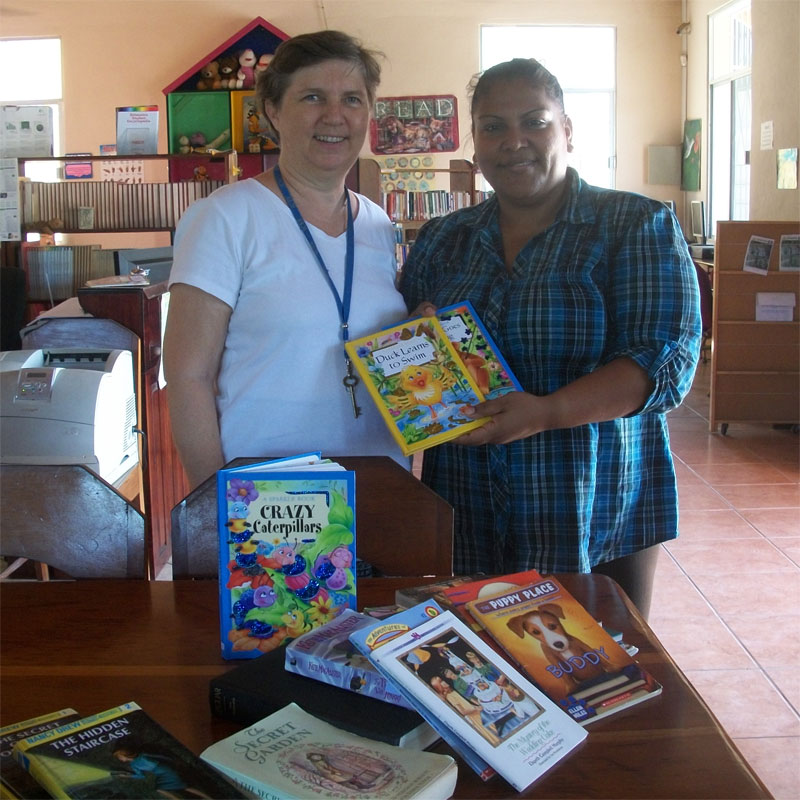
![]() |
| Dr. Nancy Adamson presenting books donated by CELA Students |
Written by Dr. Nancy Adamson, Executive Director for Center for Engaged Learning Abroad (CELA)
Thursday, 29 October 2015
5 Things That Happen When You Study Abroad in Belize
Belize is a Central American country and a Caribbean nation, too. Students studying abroad are exposed to a variety of cultures including Maya, Garifuna, Creole, East Indian, Mennonite and Chinese. The biodiversity is astounding and as enriched as the cultural exposure.
Many first time study abroad students have perhaps traveled to Canada, Mexico or the Caribbean with their families or churches. A few have been on other study abroad trips. Some, however, have never been out of the US or Canada and one or two have never flown before.
Our students complete a review about the program when their course work is over. We regularly get feedback like “awesome”, “amazing,” or “an experience of a lifetime.” What the students say when they reflect more deeply about their time studying abroad makes the efforts to get them here, keep them safe and healthy, and send them back to their lives in North America all worthwhile.
Here‘s what you'll experience when you study abroad in Belize:
1. You will grow in confidence
Let's face it, it is scary to leave your home comforts and head out into the world on your own but taking that leap of faith and overcoming your fears is a massive confidence booster.
“My time is Belize gave me the confidence that I can travel to new countries by myself and more confidence in my social abilities.”“I feel as though I have become more confident in my abilities in vet medicine and in life overall.”
“It's given me, not only knowledge, but confidence in the way I carry myself and my work ethics.”
“… psychologically I am in a better state. Before coming to Belize, I was scared to travel by myself specially since I was emotionally unstable, but now that I am heading back home, I feel more confident and affirmative than ever.”
2. Your world view and appreciation for other cultures has expanded
If you want to experience different ways of life Belize is the perfect place to study abroad from the impressive historical Maya sites to drumming classes with the Garifuna. With easy smiles and a warm welcome you are sure to take home some lasting memories.“… many people don't realize that we don't need much in life to be content. All these ethnic groups that I was able to interact with have the most satisfying expressions even if Western civilization consider them as poor people. In my eyes, they are rich with tradition, knowledge, spirituality and love. Next, spiritually I felt at peace with myself and others through the encounters with spiritual healers.”
“I am forever changed by my time here. I love the love here, love of family, love of friends, love of life. The course was amazing, but the culture and beauty is something I will share with everyone. This has changed my life.”
3. You'll make new, lifelong friends from all over North America
If you take our 2 week or 4 week programs you'll be surrounded by other like-minded (and nervous) students from Universities across North America. Being immersed in the program as a team brings people together in a way like no other.
“I met some incredible people and I know that we will be lifelong friends.”
“I would consider my fellow classmates to be friends that I will stay in touch with for a very long time. All in all, I'm not sure I could ever ask for a better experience.”
“I think it developed my skills under pressure, opened my eyes to a world of opportunities, and gave me lifelong friends. I will use what I learned here in every aspect of my future vet work and life overall.”
4. You'll experience new “ways of being”
“I felt that this allowed us to get an idea of the way of life and culture here in Belize.”
“I really learned to appreciate the difference in culture here in Belize. Even though the people have a different way of life, they are in many ways similar.”“It was really neat to see the difference in lifestyles and culture. I think my time in Belize will prove to be rewarding and make me fall in love with my potential future more.”
“We had a great amount of immersion in the culture and environment of Belize by staying in multiple places. We stayed in the jungle, on the Cayes, and in San Ignacio, all of which gave us the opportunity to meet the local people and experience their way of living.”
“It changed my view of Central America and the places that I want to travel to in the future. I had time to talk to people and see their country and mine from a different perspective.”
“I think it just helped me gain a more global perspective on life. A necessary component to any student’s life.”
5. You'll become profoundly aware of your life in North America
Of course at some point you have to go home, your experience here will give you a new perspective and you'll never look at things in quite the same way again.“It is really a privilege to see how things are done differently in a developing country and it really gives you a new perspective on not only veterinary medicine, but life in general.”
“I came back from Belize with a broader view on how people from third-world countries live and I can say I am humbled from seeing Belize.”
“Allowed me to appreciate what I have back home.”
“It really made me realize the conditions in countries other than the U.S. and how things aren't always as readily available. It taught me to be flexible and to always have a good outlook on life because some people and animals have it much worse off. “
“My time Belize really made me appreciate the little things in life. It was great to see how the culture is different in Belize from The US.”
“It also reinforced to me how privileged a life I lead at home and what luxury my family and my animals and I have.”
“It really made me realize how over the top veterinary medicine is in the United States and just everyday life in general.”
Written by Program Director Cynthia Reece
As a Program Director for our field courses in Belize, I work with North American students who are interested in studying abroad with the Center for Engaged Learning Abroad. One of the big draws for our courses, other than the field work, is Belize is an English speaking nation. Our courses are intensive and are delivered over a two week period using Belize as the classroom. Students can take two classes and stay for a full four weeks. Both features give students an opportunity to try studying abroad for the first time.
As a mom myself, this is the kind of growing I would want my college aged child to experience. I feel responsible to all the moms and dads out there when they allow their kids to study with us. I’ll leave you with my favorite response and why I live in Belize:
“This has been the most amazing experience of my life. Every day I thought "Today is the best day of my life." and every day Belize would prove me wrong. The sheer biodiversity and beauty of this country is something that is unmatched anywhere in the world.”
Saturday, 24 October 2015
What’s the Meaning of Life: Belize, Education and a Sense of Well-Being by Prof Laura McClusky
In 1994, I did research in southern Belize among Mopan Maya.
When I first came to the village where I ended up doing my research, I wasn’t
sure exactly what I was going to study.
My interests in graduate school at SUNY Buffalo Department of
Anthropology were all over the place: I was interested in midwifery, gender
construction, medical anthropology, dream theory, and psychological
anthropology. While in the village topic came to me, not because I sought it
out, but because it became evident one day while I was sitting in a hammock
day-dreaming about coming back to the village to study. I knew Belize was the
place I was going to do my work. It felt right. I felt at home in many ways. But
I didn’t know what I was going to study.
That’s when a young woman found me and tried to sell me a
basket, much like many Maya women in Belize would do at that time. Maya women,
then, and today make basket to sell to tourists. It helps them to have money at
hand for little things like soap, cooking oil and most of all school supplies
for their children.
The problem was I already had more baskets than my meager
graduate student budget could afford. But this didn’t stop her. She slowly
showed me each basket she had made. At the time I didn’t understand how time
consuming basket making was. I was unimpressed and frankly, I tried to ignore
her. She persisted, and there were many
awkward silences between us. Then, she told me her husband beats her.
I froze. I didn’t know what to do. I was unprepared for such
conversation, so I got up and left. I wasn’t proud of that, and it haunted me.
It haunted me so much it became my topic of study.
Spousal abuse wasn’t a big topic in anthropology at the
time. My research and subsequent book “Here, Our Culture Is Hard”: Stories
of Domestic Violence From a Maya Village in Belize (University of Texas
Press 2001) was the first book length ethnographic study that made spousal
abuse its focus. Since then others have embarked on the study, and soon another
book on domestic violence in Belize will come out focusing on the western part
of the country.
What I learned helped people understand that spousal abuse
is common worldwide, but the ways different peoples deal with it is
significant. I found, at that time, in the village where I did my work, that
Maya women protected each other from spousal abuse. Even though their society
had many elements of a patriarchy, a system in which men are privileged, women
created mechanisms to help each other deal with violence in the home. It’s too complicated to deal with all of it
here, but I’ll tell you about a part of it that is the foundation for my next
extended research project. I’ll tell you about gossip and education.
In 1994, mothers often made sure their young marriage-able
daughters heard about any incidence of spousal abuse that she knew about.
Fodder for gossip came easily since Maya women do not hide when they are hit by
their husbands. Rather they talked about it openly and honestly. No hidden
bruises, no stories of how they were clumsy and somehow caused any visible
bruises themselves. Nothing was hidden, like it often is in the US. Women did
not feel they were somehow at fault and deserving of their bruises, like they
often are here in the US. They were
clear about abuse, and they were clear about who was at fault.
That’s similar to what we believe in the US. Education gives
you opportunities, and opportunities can help you avoid all sorts of bad
situations. Education is the key to a good life. This was a radical idea in southern Belize at
the time, especially since just a few years prior to my research, Maya arranged
marriages. It was a different world, a different way of thinking. At that time
building a family was key to establishing solid social relationships and those
solid relationships were what allowed you a good life. Maya success depended on staying connected to
others, which often meant serving the community in various ways.
At the time of my field stay, going to school was also just
becoming possible for young women as the village now had daily bus service to the
District capital of Punta Gorda (PG) where the high school was located. Prior
to having bus service to PG mostly only boys went to high school. Parents felt
it was too risky to allow girls to go since they would have to find lodging far
away from home. In PG they might not have a social network strong enough to
prevent her, in her loneliness, from developing a relationship with an
irresponsible boy. The fear was she would return home pregnant and for Maya, at
that time especially, a single mother found it difficult to find a good man to
marry. Buses allowed young women to stay home at night, and go to school
during the day.
But something interesting was happening. Young girls going
to high school were re-creating Maya gender roles. High School girls wore
different clothing, talked freely with young men, took important positions in
the household doing accounting for their mothers basket selling, they were changing
gender roles. Women were gaining independence.
So what is my research now?
Well, after twenty years, times have changed. Education is
not so difficult to get in Belize, although for many it requires more resources
than are available and more time away from running a successful household than
is possible. Besides that, studies in
the US are suggesting that economic freedom is not enough to have a sense of
well-being. Some suggest well-being is comprised of five elements: career,
social, financial, physical and community.
The Gallup-Purdue Index of well-being for college graduates in the US uses
these five elements to access college graduates sense of well-being in the US.
The Gallup-Healthways Well-Being Index also uses these five elements and has
declared that Belize is fifth in the world for it population thriving in four
of the five elements of well-being.
Laura McClusky is a Professor of Sociology and Anthropology
at Wells College.
Sunday, 18 October 2015
A little bit about us
Our organization was born in 2010 when a group of friends and co-workers decided Belize had so much to offer students and professionals in unique learning experiences that we formed a company to assist those who wanted to visit, study, and learn about Belize. Coming up with a name which expressed what we wanted do was actually much harder than we thought. We wanted to convey our educational purpose with a focus on sustainability. We decided on I.S.I.S which stood for the Institute for Sustainable International Studies. We know Isis is the Egyptian goddess of the earth and the patroness of nature, so our initials were quite apt. The fact that Dr. Nancy, our Executive Director, also has a cat called Isis sealed the deal.
Then, as you all know, the civil war in Syria escalated and a group of extremists decided that a Caliphate was what the middle east needed and the media took to calling them ISIS. We waited to see what would happen, relieved that people were smart enough not to mix us up! In the end, with so much negativity around that acronym we decided that we would change our name. After much head scratching we decided to call ourselves Center for Engaged Learning Abroad, C.E.L.A. Belize.
We love sharing the wonders of Belize while providing educational services to students here. We are thrilled to see the sense of awe when students experience new knowledge first hand through their field work and community service. Belize challenges students to move outside their comfort zone. Our students achieve amazing results when they do something they didn't think they could or have never tried before. Watching a student grow personally with a new view of the world makes us feel C.E.L.A. has accomplished something worthwhile.
C.E.L.A. isn’t just about the few of us who founded it either. It is about the community of people who teach, live and work in Belize and provide services to our students. Student fees contribute to the development of Belize through donations to local organizations, contributions to communities for service learning projects and the employment of Belizeans. We are proud to be Belizean and building this great little country.
Subscribe to:
Posts (Atom)